Monday, July 10, 2017

The Four Marks of a Self-Conscious Robot

In his latest book, The Silver Species, Lawsin demonstrated how to develop a self-programming algorithm based partially on a simple flowchart he named The Four Marks of a Conscious Robot. 

1. It can transcodify information to physicals; the primary indicator of consciousness.
2. It can transform physicals into actions or movements; the first universal instruction.
3. It can transfer motions into mechanical, repetitive, or autonomous actions.
4. It can translate the mechanical persona (feeling, thinking, behaving) like of the homodruinos into a learned instinct "conscious being".

Before we discuss in details how the Four Marks can make a self-conscious robot, let us define first what are consciousness, subconsciousness and unconsciousness? Then, let us find out if consciousness and subconsciousness really exist or are they just illusions? And finally, does consciousness emerge in the brain or is it all mechanical; an action-reaction, sensor-actuator type of emergence?

English philosopher John Locke viewed consciousness as a psychological concept defined as "the perception of what passes in a man's own mind". In the early 19th century, the concept was considered - as a kind of mental substance totally different from the physical world. In neuropsychology, it is defined in terms of alertness or responsiveness characterized by the patterns of electrical activities in the brain recorded by a device known as electroencephalograph.

Meanwhile, psychoanalysts define subconsciousness as a mental processes occurring just below the level of awareness. It is a zone between the conscious and the unconscious. Although in popular usage, subconscious and unconscious are often taken as synonymous, the distinction can be defined by examples like sleeping is to subconsciousness as comatose is to unconsciousness.

In my opinion, consciousness is a product of data gathering. It is like gathering the necessary ingredients (heat, fuel, oxygen) to produce fire. Fire is to consciousness as heat, fuel, oxygen is to read, think, write. When the body receives information, processes such information, and uses the information, the body becomes mechanically conscious. When the body knows what its doing, the body becomes physically self conscious.

Automatons are examples of mechanically conscious objects. But are they aware of themselves? Do they have the perceptions for what they are programmed? Do they know what they are doing? Can they be considered conscious? Do they have the ability to label physical objects? Do they have the ability to transform these physicalities to abstractness? Do they have the ability to transform these abstractness to physicalities ?


 ==================================================================
"The consciousness of the mind 
is less powerful than the subconsciousness of the body." 
~ Joey Lawsin
==================================================================

NOTICE: Articles on this site are composed on random thoughts. The transcript may not be in its final form. It maybe edited, updated or even revised in the future based on the outcomes of  the author's experiments.

Public Domain Notice: Copyright (c) 2000. All rights reserved. This article is part of a book entitled Biotronics: The Silver Species. Copies are welcome to be shared or distributed publicly as long proper citations are observed. Please cite as follows: The Biotronics Project, Joey Lawsin, 1988, USA.

================================================================== 
The Homotronics® and Homodruinos® logos are registered trademarks.
Copyright Biotronics© Inc. iHackRobot®. All Rights Reserved.
Patent Pending. 2000 © ®
 ==================================================================


" Consciousness is the ability of an object to transform physicalities 
to abstractness or vice versa. " ~ Joey  Lawsin


Sunday, May 14, 2017

Amazing Tiny Brains Creating Super Complex Structures

Spectacular videos that might change your perspective about intelligent brains!

A tiny pufferfish, with a small size brain, creating intricate "crop circles" on the seabed using only its fin, cleaning all out the debris on the sand structure, decorating its construction, and  planning to attract a mate.


Ants, another small creatures with very small brains, creating a super complex colony complete with air-conditioning, waste disposal and family hierarchies.


A spider, another creature with a small brain, constructing a very intricate web pattern


Wasp, another being with a small brain, building complex almost perfect patterns of hexagonal nests, with the ability to count the number of nest for each offsprings.


Bird brain means stupid? Think again after watching this bird sewing its nest.


Since I was a kid I have been playing with these cute tiny bugs. What fascinate me about these insects, either called sow bugs or pill bugs, was they can be found everywhere. Sometimes I even thought them as the Holy Grail of Evolution because they can be found in all parts of the world as well. I encountered them in Alaska, Europe, Asia, Africa, Australia, North and South Americas.


Now, are all these insects have intelligent brains? Are they aware of themselves? Do they think? In psychology, the awareness of one’s own ability to think is called metacognition. It is thought to reside on a region of the brain called the prefrontal cortex that stores many cognitive functions like planning and reasoning. It is believed to be the common factor that distinguishes humans from other species.

If the prefrontal cortex permits metacognition, then species that demonstrate metacognition are self-aware and have the ability to think. However, simply identifying which species exhibit self-aware behavior has been proven to be tricky because no reliable behavioral tests for the trait exist.

In 1970 Gordon G. Gallup, Jr., of the University at Albany, developed the “mirror test” to assess metacognition in chimpanzees. However, some of the chimps failed to recognize themselves thus causing certain scientists to consider the test unreliable.


 ==================================================================
"There are no such things as problems;
problems only exist because of laziness." 
~ Joey Lawsin
==================================================================

NOTICE: Articles on this site are composed on random thoughts. The transcript may not be in its final form. It maybe edited, updated or even revised in the future based on the outcomes of  the author's experiments.

Public Domain Notice: Copyright (c) 2000. All rights reserved. This article is part of a book entitled Biotronics: The Silver Species. Copies are welcome to be shared or distributed publicly as long proper citations are observed. Please cite as follows: The Biotronics Project, Joey Lawsin, 1988, USA.

================================================================== 
The Homotronics® and Homodruinos® logos are registered trademarks.
Copyright Biotronics© Inc. iHackRobot®. All Rights Reserved.
Patent Pending. 2000 © ®
 ==================================================================


Tuesday, April 25, 2017

The P vs NP Millennium Problem

The mathematical expression, P != NP,  is one of the seven millennium problems that even to this day has never been solved. The P vs NP is a mathematical problem that inquires if a computer has the ability to verify the solution of a problem, does it has also the capability to quickly solve the problem without undergoing into a series of data gathering. The author was intrigued in solving this problem due to the reason it can provide a clue on how to create a self conscious robot.

A good example of this PNP problem is finding a particular person on a list of names. Man and computer have the ability to easily locate a given name on a database. However, man and computer have no capability to quickly find the same name without scanning every name on given list. The ability to easily locate is the P statement, while the no capability to quickly find is the NP statement.

Is there a solution to the NP problem? Can the NP problem be solved?  This article will attempt to provide some meaningful solutions to the problem based on the principles behind I.M., the study on the development of algorithms and smart materials needed to produce a self conscious robot.

According to Information Materialization, P is not equal to NP. The conclusion is supported by the following theories commonly know as the Principle of the Four Causes.
a) The Caveman in the Box Theory
b) The One-to-one correspondence Label
c) The Scriptional Jump
d) The Algorithm of Queue

Based on the Caveman in the Box, Nature is the container or storage of information. Mother Nature is the keeper of all objects that we see, hear, touch, smell, and taste. She is the holder of the universal list that contains the database of all living and non-living things. Objects like plants, birds, fish, elements, rocks, etc, are inherent information. Even their actions, shapes, movements, behaviors, features are also pieces of information that can be inlearned, copied, or acquired by the same humans, animals, and plants. They are the original sources of information. Nature is the Mother of all Information..

Information can only be acquired in two and only two ways: by choice and by chance. By Choice means information can be obtained from parents, teachers, books, schools, friends, lessons from animals or from nature, while By Chance means information can come from discovering new things, fortunate accidents, unexpected experiences, unknown events or nature's interventions. Whatever the case, the bottom line is every piece of information can be acquired or borrowed originally from one's environment.Humans, animals, plants, and the environment are individually pieces of information.

Information flows only in one direction - from the inherent world to the interim mind, from outside to inside, from physical to abstract. This one way principle is sometimes called the Scription Jump. As one of the signature theories of Originemology, it. is concerned with the following ingenuous questions: (i) Can I think of something without associating it with a physical object? If I think of an idea, is the idea real without a physical object associated to it?  (ii) When does an abstract idea become physically real? Is the idea of the letter "I" real when I write it on a piece of paper? If so, how does this abstract figure become a physical reality without being naturally inherent? (iii) How does my letter I "jumps" from abstract to physical?

Like the ideas of Zero and One, both are abstract concepts. They only exist in the mind by assumption. Mathematically, both words are called numerals by definition. When Zero is represented with the symbol 0 and One with 1, technically the words become numbers by association. Numbers are the assumed physical representations of the abstract numerals. By symbolic representation, both digits now exist materially outside the mind - the physical world; the world outside of ourselves, the inherent world that exists long time independently before the mind existed.

However, although 0 & 1 are created by definition, association, representation and assumption, can we now really consider these numbers as concrete objects or physical solid materials? If I write 0 and 1 on a paper, are they now materially or physically real? Can we consider the written numbers proof of their reality or existence? Can the numbers now be considered solid evidence and be accepted as real? How can we validate the paper evidence to be true, false, valid, or real? Are the numbers really existing or are they still abstract, imaginary or imagined?

Humans can learn things through the process known as one to one correspondence. This is accomplish through association, definition, representation, assumption or tagging, a method collectively called Labeling. We call a fruit an apple by definition, association, representation or by labeling. However, the apple can be changed to orange or pineapple depending on the rule of the majority. If the majority accepts that the apple should be named orange, then the majority wins.

When an object acquires, codifies, stores, retrieves and processes information, the object is perceived as an intelligent entity. Humans, although notorious as short-term thinkers, are believed to be intelligent because they possess these five basic functions. However, bacteria, algae, fungi, plants, animals and other natural objects like rocks, air, water are constantly experiencing some of these functions as well. These non-living objects embrace at least one of these five basic functions and some man-made objects like computers and robots are functioning artificially intelligent as well.

In order for a computer to execute NP it has to subscribe on five basic requirements:
First, a vast cache of information must be ready to be "read".
Second, the more complex a system becomes, the more materials and information are needed.
Third, the complexity of a system depends on the availability of materials found on its environment.
Fourth, the more materials, the more complex the algorithm becomes
Fifth, the flow of data must be delivered through the algorithm of Queue.


Excerpt: Creation by Law 1988


 ==================================================================

==================================================================

NOTICE: Articles on this site are composed on random thoughts. The transcript may not be in its final form. It maybe edited, updated or even revised in the future based on the outcomes of  the author's experiments.

Public Domain Notice: Copyright (c) 2000. All rights reserved. This article is part of a book entitled Biotronics: The Silver Species. Copies are welcome to be shared or distributed publicly as long proper citations are observed. Please cite as follows: The Biotronics Project, Joey Lawsin, 1988, USA.

================================================================== 
The Homotronics® and Homodruinos® logos are registered trademarks.
Copyright Biotronics© Inc. iHackRobot®. All Rights Reserved.
Patent Pending. 2000 © ®
 ==================================================================


Saturday, February 25, 2017

T.U.R.N. - The Ultimate Robotics Navigator

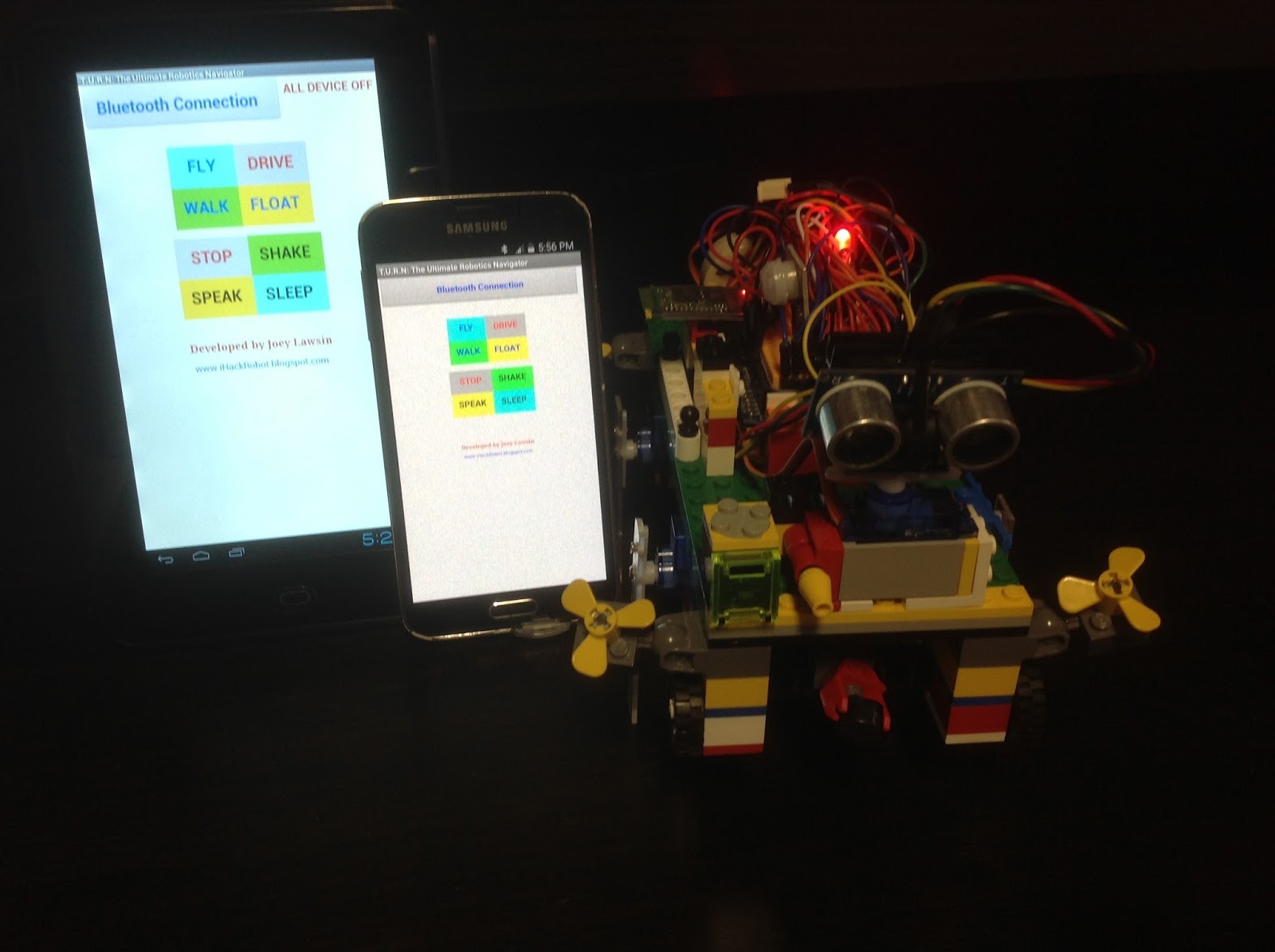
T.U.R.N. ®, an acronym for The Ultimate Robotics Navigator©, is the first autonomous robot of its kind that can navigate through rough terrains with 4 wheels, 4 legs or 4 propellers and an option to scout underwater. This robot, also dubbed as M.C.Z.P., pronounced as mississippi, is a multi-purpose 4 in 1 configuration engineered to provide the robot options to fly like a drone, walk like an insect, drive like a rover, and swim like a duck.

A state of the art aerial video system with a 3-axis stabilizer and HD camera is also attached on its body (not shown). It can be wirelessly controlled using an android phone or tablet through the app below. The robot can think, hear, smell, see, feel and balance itself. The robot can copy what information it senses, store these pieces of information on its microprocessor, label them digitally in a queue, and process them like a living organism.

M.C.Z.P. on wheels
M.C.Z.P. on its legs

M.C.Z.P. on its propellers

T.U.R.N. = The Ultimate Robotics Navigator App for McZP.

This robot can be controlled using an app. The app, which was programed by the author, can wirelessly control the robot using an android tablet or phone to drive, fly, walk and swim (still working on this feature) in all directions. It can also talk, drop dead, bow, sleep, and act as a security device by detecting motion(hear), triggering an alarm(shout), and flashing bright red leds(see).

T.U.R.N. = The Ultimate Robotics Navigator Apps


Disclaimer:  We shall not be liable for any loss or damage of whatever nature - direct, indirect, consequential, or otherwise - which may arise as a result of your use of any information on this website. However, if you are interested in using any of the projects for personal or educational purposes, please inform the author by email. 


 ==================================================================
"Unless SETI can find an earth-like environment in other planets;
  their search to find intelligent beings means nothing but failure."
~ Caveman in the Box, Joey Lawsin 1988
==================================================================

NOTICE: Articles on this site are composed on random thoughts. The transcript may not be in its final form. It maybe edited, updated or even revised in the future based on the outcomes of  the author's experiments.

Public Domain Notice: Copyright (c) 2000. All rights reserved. This article is part of a book entitled Biotronics: The Silver Species. Copies are welcome to be shared or distributed publicly as long proper citations are observed. Please cite as follows: The Biotronics Project, Joey Lawsin, 1988, USA.

================================================================== 
The Homotronics® and Homodruinos® logos are registered trademarks.
Copyright Biotronics© Inc. iHackRobot®. All Rights Reserved.
Patent Pending. 2000 © ®
 ==================================================================

Saturday, December 24, 2016

iHackRobot Apps


APPS Features
Android Arduino Controller App
  1. Green to turn Device ON
  2. Red to turn Device OFF
  3. Bluetooth Selection button
  4. Developer's name
  5. Developer's Website
Bluetooth Scanner App
  1. Bluetooth scan
  2. Select HC05
  3. Device pin 12345
  4. Activate HC-05
Scribble & Swipe Ball  App

  1. Draws RGY lines
  2. Draws small dots
  3. Draw big dots
  4. Ball swipe
  5. Dog speaks
  6. Shake to erase scribbles
Smash the Bugs Game

  1. Smash the bug
  2. Hit = 1 point
  3. Score counter
  4. Reset button
  5. Add more bugs
LED Bluetooth Controller

  1. Green speaks Device ON
  2. Red speaks Device OFF
  3. Bluetooth Selection button
  4. Accelerometer shake
  5. VoiceTranslator
Home Appliances Control Station

  1. Connect to Bluetooth
  2. Turns On/Off device  1
  3. Turns On/Off device  2
  4. Turns On/Off device  3
  5. Turns On/Off device  4
  6. Turns On/Off device  5
  7. Turns On/Off device  6
  8. Shake to turn ALL off
Talking Zero

  1. Zero meows when tap
  2. Button gives instruction
  3. Bug tilts as iphone tilts
  4. Voice alert when shaken
  5. Tells time and date

  1. Connect to Bluetooth
  2. Activates device 1
  3. Activates device 2
  4. Activates device 3
  5. Activates device 4
  6. Activates device 5
  7. Swipe to deactivate

Generic Robotics Control Pad
  1. Activate Bluetooth
  2. Robot moves Forward
  3. Robot moves Backward
  4. Robot moves Left
  5. Robot moves Right
  6. Robot plays dead
  7. Robot speaks 
  8. Robot sleeps
  9. Shake phone to deactivate
  1. Activate Bluetooth
  2. Robot drives itself
  3. Robot walks
  4. Robot flies
  5. Robot swims
  6. Robot plays dead
  7. Robot speaks 
  8. Robot sleeps
  9. Robot detects motion 
  10. Robot sounds an alarm
  11. Shake phone to deactivate

  1. Activate Bluetooth
  2. Select HC-05
  3. Tap Microphone Icon
  4. Speak On to turn on light
  5. Say Off to turn off
  6. Say blink to blink led
More Apps to Come -------


Warning: : If an application is requesting permission to access any information of your phone or tablet, it is your sole own discretion if you provide permission or not. IHackRobot is not affiliated with the contents of the application or even its owner.

Disclaimer: We shall not be liable for any loss or damage of whatever nature - direct, indirect, consequential, or otherwise - which may arise as a result of your use of any information on this website. However, if you are interested in using any of the projects for personal or educational purposes, please inform the author by email.

Public Domain Notice: (c) 1988 Joey Lawsin. All rights reserved. This article is part of a book entitled Biotronics: The Silver Species. Copies are welcome to be shared or distributed publicly as long proper citations are observed. Please cite as follows: Biotronics: The Conscious Robots, Joey Lawsin, 1988, USA.

==================================================================
The Homotronics® and Homodruinos® logos are registered trademarks.
Copyright Biotronics© Inc. iHackRobot®. All Rights Reserved.
Patent Pending. 1988 © ®
==================================================================

(c) 1988 Joey Lawsin. All rights reserved.

Sunday, November 27, 2016

Brain Experiments on Robotics

This is a simple brain experiment that I have discovered when I was developing an android game app for my nephew EJ. The app is a game about smashing as many bugs as you can to score more points. The app, when installed on your tablets or phones, sounds off the word "HIT" every time a bug is killed. The word HIT is simply an indicator that tells you just smashed a bug.

Smash d' Bugs App

However, when you mentally substitute the word HIT with the word "HIP", after a few minutes of playing and hearing, eventually the brain will now "hear" HIP instead of HIT. The brain simply switched on from HIT to HIP.

Interestingly, after the switch, the most weirdest part of the experiment happens when - even you try to replace or bring back the word HIP to HIT mentally, your brain mentally would not allow you to do the switch anymore. Why?

Do we really store information in our brains or, just like a cd disc or a music box, is the brain simply made up of ridges (crests and troughs) that naturally produces the sensation of information? Or just like sponges and jellyfish, do they simply react to the ocean waves just like swaying branches and leaves that react to the force of the wind?  Remember these animals,  even though they don't have brains, hearts and blood, have survived before humans evolved. Does this mean we don't need our senses afterall to live thrive, and survive?

To find answers to these questions, let me discuss first the following theories based on I.M. :
  • The Xylophone Analogy
  • The Reversible Hello
  • The Caveman in the Box
  • The Animation Effect
  • The sponge/jellyfish biological structures
  • The Skin Network: The Cobweb Analogy
  • The Information Screen
  • Scriptional Jump
  • The ZiZo effect
  • Law of Second Option or The Flowchart Effect
Other homonyms will also be included in the experiment to analyze their effects on voice recognition and translation as inputs and outputs.

Here are some samples of sensory based experiments:


 ==================================================================
"Without the physical world,  Ideas will not exist."  ~ Joey Lawsin
==================================================================

NOTICE: Articles on this site are composed on random thoughts. The transcript may not be in its final form. It maybe edited, updated or even revised in the future based on the outcomes of  the author's experiments.

Public Domain Notice: Copyright (c) 2000. All rights reserved. This article is part of a book entitled Biotronics: The Silver Species. Copies are welcome to be shared or distributed publicly as long proper citations are observed. Please cite as follows: The Biotronics Project, Joey Lawsin, 1988, USA.

================================================================== 
The Homotronics® and Homodruinos® logos are registered trademarks.
Copyright Biotronics© Inc. iHackRobot®. All Rights Reserved.
Patent Pending. 2000 © ®
 ==================================================================

Thursday, November 24, 2016

Generic Robotics Apps

 
Arduino Robot controlled by Android Smartphone
by iHackRobot on Vimeo.


Arduino Sketch:
/* ===============================================================
      Project: Android Smartphone with Arduino Bluetooth
      Author: J. B. Wylzan 
      Website: http://www.ihackrobot.blogspot.com
      Abstract: How to control an led using smartphone
================================================================== */

#include <SoftwareSerial.h>
SoftwareSerial BTserial(2, 3); // RX | TX

 int ledPin = 12;
char data = 0;  

void setup()
{
     pinMode(ledPin, OUTPUT);
     BTserial.begin(9600);
     // Serial.begin(9600);
     // serial.println("Hello World");
}

void loop()
{
    if (BTserial.available())
    {
    data = BTserial.read();              //Read incoming value and store it into data
    if(data == '1')                            //when data is equal to 1
      digitalWrite(ledPin, HIGH);     // then LED is ON
    else if(data == '0')                     //when data is equal to 0
      digitalWrite(ledPin, LOW);     // then LED is OFF
       }
}


Another Version of the Generic Robotics App

Warning: : If an application is requesting permission to access any information of your phone or tablet, it is your sole own discretion if you provide permission or not. IHackRobot is not affiliated with the contents of the application or even its owner.

Disclaimer:  We shall not be liable for any loss or damage of whatever nature - direct, indirect, consequential, or otherwise - which may arise as a result of your use of any information on this website.


 ==================================================================
"Without the physical world,  Ideas will not exist."  ~ Joey Lawsin
==================================================================

NOTICE: Articles on this site are composed on random thoughts. The transcript may not be in its final form. It maybe edited, updated or even revised in the future based on the outcomes of  the author's experiments.

Public Domain Notice: Copyright (c) 2000. All rights reserved. This article is part of a book entitled Biotronics: The Silver Species. Copies are welcome to be shared or distributed publicly as long proper citations are observed. Please cite as follows: The Biotronics Project, Joey Lawsin, 1988, USA.

================================================================== 
The Homotronics® and Homodruinos® logos are registered trademarks.
Copyright Biotronics© Inc. iHackRobot®. All Rights Reserved.
Patent Pending. 2000 © ®
 ==================================================================